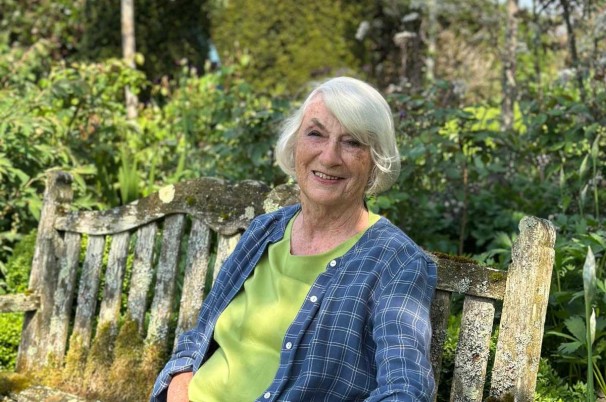
Gardeners’ World recently filmed our EGS founder, Rosemary Alexander at her celebrated garden at Sandhill Farm House. The episode aired on Friday 24th April so we hope you enjoy viewing on catch up if you didn’t already see it. It’s amazing to think that Rosemary founded the school in 1983, before The Chelsea Physic Garden was even open to the public.
She started teaching the equivalent of the Good Gardening Diploma as there didn’t seem to be any other course that covered the best of horticultural techniques, gardening and planting design in the way she thought it should be. We’re not sure there is another course like it to this day, so what foresight! Shortly afterwards, Rosemary, a landscape architect by training, added the design diploma and the rest is history.
We’re proud to continue her long legacy on garden education, adhering to the methods and principles that she so carefully set out in her writing as well as her teaching over the years and we still refer to her garden at Sandhill to teach many of those principles.
Essential Garden Design Diploma
Why is the course only 3 months long?
Frequent questions from those applying to the Essential Garden Design Diploma are why it is only 3 months long, and why it runs from January to March when gardens are quieter.
There are a few answers. Firstly, for many students who go on to the design course from our one year Good Gardening Diploma it acts as an additional term. Spatial design is not covered on Good Gardening and adding this knowledge to their already extensive horticultural knowledge allows students to move into the field of Garden Design. Secondly, it attracts many mature students who are still working or running their own businesses.
Changing career is never easy and this course allows students to take a short sabbatical before either fully taking the plunge or slowly moving towards a career in garden design. Many students also come to us who are already working in the horticultural sector as landscapers, gardeners or planting designers and January to March is the quietest time of the year for them to step away. Lastly, it allows students from overseas to join us on a 90 day visa.
We frequently have students from the USA, where, somewhat surprisingly, courses specifically on garden design don’t seem to exist.
On such a short course, all students work on just one real project. It is always a challenging one at a scale that allows a full exploration of how to design space confidently and going step by step to cover all fundamental aspects of garden design allows a thorough understanding of the process. We don’t teach software skills on the course, preferring students to draw by hand.
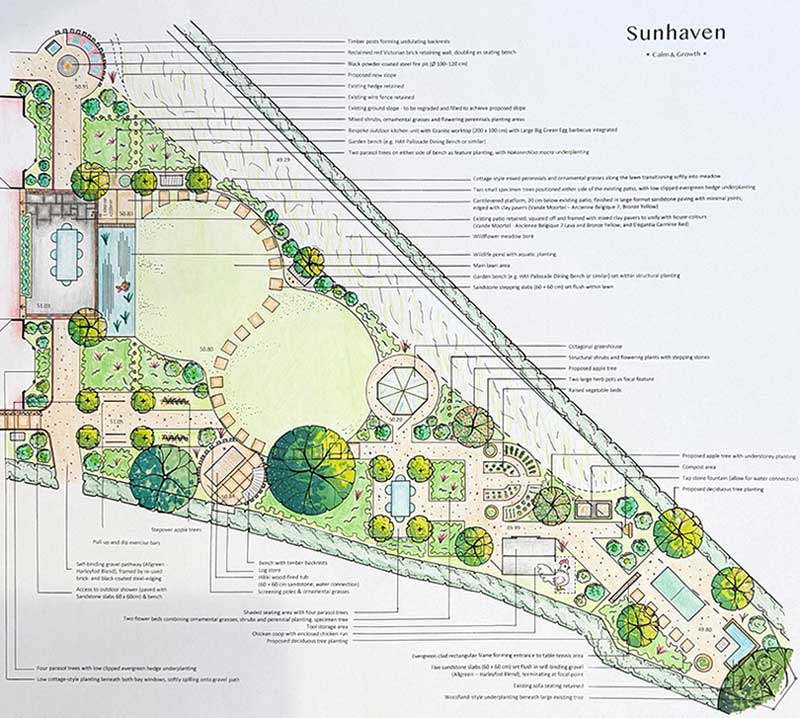
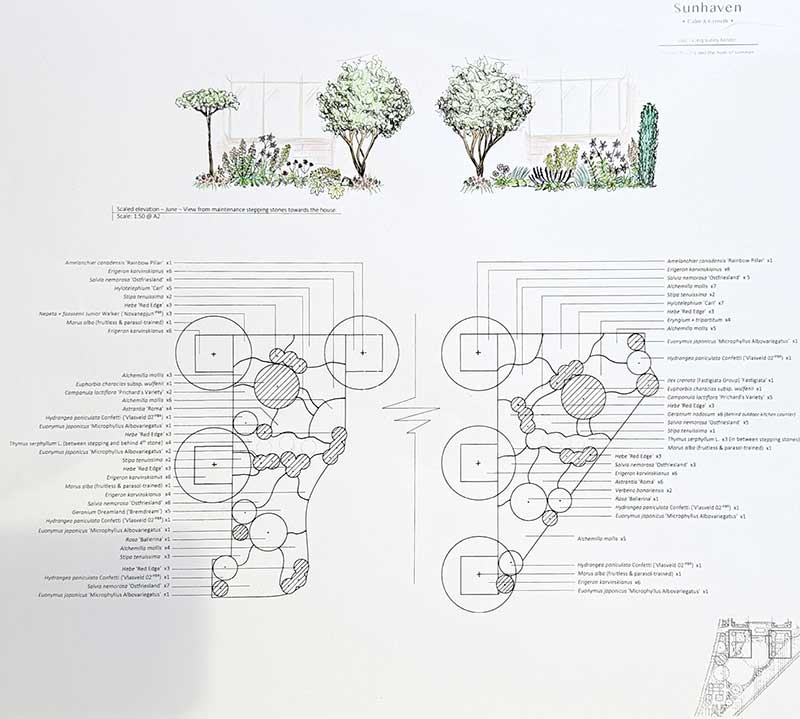
This allows students from all backgrounds to start at the same level, and to leave with a very useful skill, as you can see from the hand drawn, hand coloured Layout Plan and Planting Plan below by one of this year’s graduates.
For those that wish to form a garden design practice or to go into a garden design studio, we refer them on to relevant software courses. Last year several students went on to learn Vectorworks with Richard Easton, and this year we offered an introduction to SketchUp with John Brooks. Many other graduates have gone on to learn a garden design workflow for iPad with John Wood using SketchUp, Morpholio Trace and Procreate.
John Wood is also at the forefront of embracing AI for garden design, an important subject that must be considered when considering which software system to invest in. Software changes fast (AI now changes daily), and we keep abreast of those changes, passing the latest knowledge on within the design course.
We also strongly encourage students who wish to work professionally to join The Society of Garden and Landscape Designers to continue building their knowledge through CPDs from the UK governing body that sets the gold standard for garden designers.
In this way, students who do want to practise as garden designers move forward confidently into the industry.
Good Gardening
In a student’s own words
Sandhill Farm House Practical Day
What better way to hear about Good Gardening than through a student’s own words? Here’s Charlotte Lipsius giving us a rundown of Weeks 13 to 15 on the diploma course, covering late January and early February:
Week 13; Wonderful lecture by brilliant Ed Flint breaking down climbers and their various forms i.e. self clingers with aerial roots like ivy, twiners such as hops and wisteria, sprawlers and scramblers like roses, brambles or solanum, and grippers like clematis or lathyrus (sweet peas). It’s important to understand the climbing habit of the plant to know where to plant them and what sort of support they will need to thrive.
Week 14; Fascinating to spend the day with Jim Hillier of Hillier Trees learning about the cultivation of trees – how they are propagated & how they are cared for until they are sold, how they are transported and planted so carefully and how to care for them while they establish in their forever home. They say the best time to plant a tree is yesterday and I couldn’t agree more.
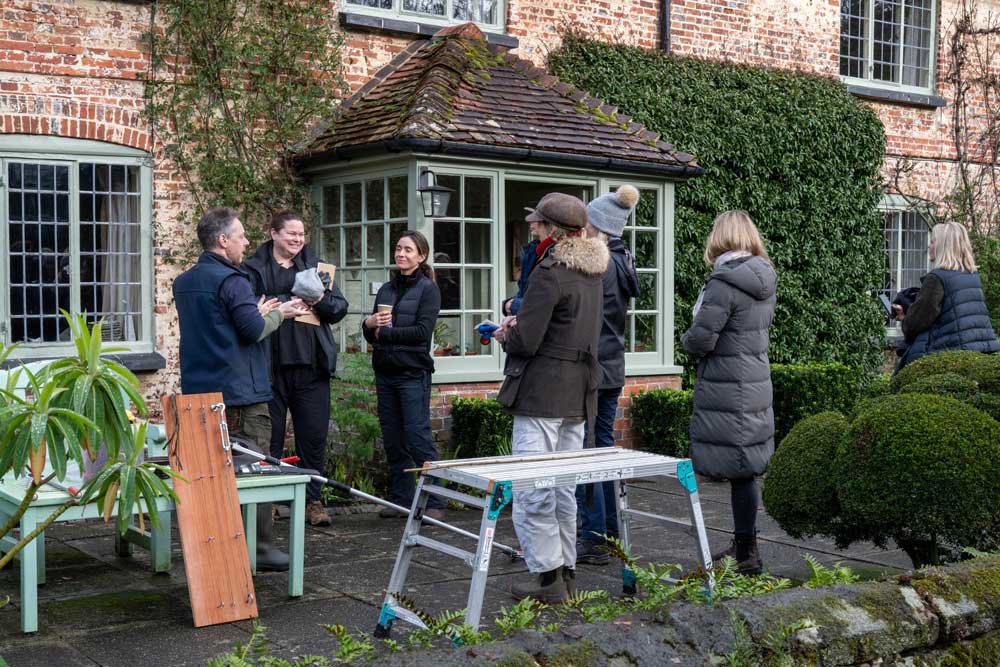
For Week 15 we were back at glorious Sandhill Farm House with head gardener Tina. There is a very mature wisteria there that we pruned together, carefully deciding which flower buds to remove and which to keep to encourage for the most successful flowering, and what wood to remove to promote the best shape and health of the plant. We also learnt how to plant bare root trees, hedges and roses as well as how to build our own plant supports with Ben Pope.
It was a beautiful sight to see the snowdrops and hellebores emerging amongst the evergreen ferns and moss covered trees. Rosemary’s garden is known for its abundance of snowdrops and there is an annual public open day for a chance to see them at their best.
Part of the Good Gardening Diploma involves learning how to write well about gardens and plants – a useful skill as some of our graduates go on to become garden journalists or social media experts.
Rosemary’s Plant of the Month
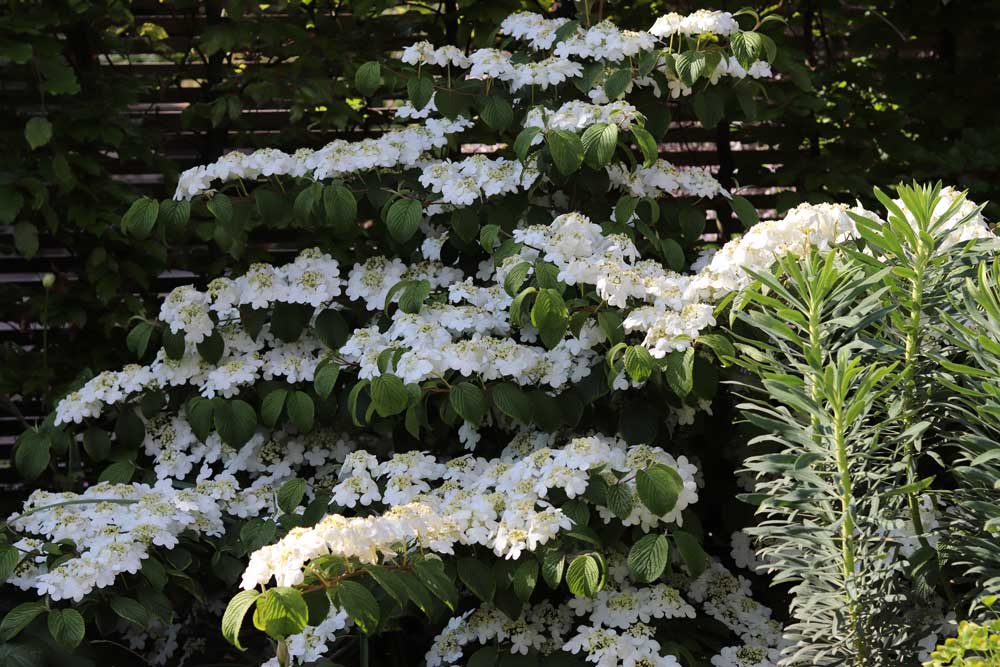
Viburnum plicatum f. tomentosum ‘Mariesii’
Viburnum plicatum f. tomentosum ‘Mariesii’ is a reliable, easy-to-grow shrub with distinctive layered branches and flat white flowers in late spring. It works well as a feature plant or in a border, adding structure without being too formal, particularly at the end of a border as a focal point or to draw your eye from something beyond. In autumn, the leaves turn shades of red and purple, giving it a bit of extra seasonal interest.
Rosemary’s Top Gardening Jobs This Month
- Keep on top of weeds! Annual weeds love this time of year for germinating and rushing into growth. Regularly go through your borders to remove weeds whilst keeping an eye out for lovely self seeders that you want to keep. Learn what the self seeders look like so you know what to keep and nurture and what to take out.
- The weather has been very dry so you may have to water the borders, we had a very wet winter so there will be water underground but plants are growing at their maximum this month so will be taking up a lot of water now. New plantings will need watering.
- Spray all box hedging for box tree caterpillar with Xentari and install pheromone box moth traps, feed it monthly to help stave off blight if the summer turns wet and help it cope with an attack of caterpillar.
- Stake perennials. Any you know are at risk of falling over later in the year can be staked using natural materials such as hazel now before it is difficult to work in the borders because of all the foliage. Early staking prevents having to remedially stake which never looks as natural.
- Tie in sweet peas and climbing roses and prune spring flowering shrubs after flowering where necessary.
- Keep succession sowing salad crops.
- Start to water all the pots regularly and feed weekly, alternating between seaweed feed and tomato feed.
Upcoming Courses and Visits
Study Day with Troy Scott Smith – ‘The Making of a Garden’
18th June 2026
For: English Gardening School Alumni only
Join us for an inspiring day on site at a new 5-acre garden near Bath, currently being designed and developed by renowned head gardener and plantsman Troy Scott Smith. This exclusive alumni event offers a rare opportunity to see a garden in its formative stages and to understand how a masterplan is developed for both the garden and wider estate.
Throughout the day, Troy will guide us through the creative, practical, and human sides of making a garden: from initial conversations with the client to putting spades in the ground, appointing gardeners, and establishing the long-term infrastructure that will support the garden as it grows.
Where possible, we will also hear directly from the owner and on-site gardeners, gaining multiple perspectives on how a new garden is envisioned, funded, built and maintained.
Garden Tour – The Barn and Old Bladbean Stud
25th June 2026 10.30am to 3pm
We are delighted to announce our EGS Summer Garden Tour to two wonderful gardens in Kent. Our Summer Garden Tour starts at the home of Andy Salter, who you may know from his Instagram @big_drewland. Andy’s garden is stuffed full of interesting plants, what a treat for the plant enthusiast.
From there, we will go on to Old Bladbean Stud, created by Carol Bruce, voted The Nation’s Favourite Garden in the South East by readers of The English Garden magazine, where we will have time for picnics before our talk from Carol and garden tour. Carol kindly shared a copy of her beautiful book ‘In Nature’s Slipstream’, which will be published in May.
Inspired by the mixed borders at Great Dixter, special effects artist Andy Salter has created a captivating plantsman’s paradise around his black-painted barn in Kent. His garden has been featured in Garden Illustrated and in Clare Foster and Andrew Montgomery’s beautiful book Pastoral Gardens. Rarely open to visitors, Andy’s atmospheric garden, surrounded by a wildflower meadow, has also appeared on BBC Gardeners’ World and Channel 4’s Garden of the Year.
Join us for a special morning as Andy personally guides us through his remarkable garden.
Driven to find a new balance between a wild and cultivated environment that could bring artistry, sustainability and resilience onto the same page, Carol Bruce created her garden at Old Bladbean Stud on 3 acres of abandoned ground as a living experiment in harnessing natural processes rather than dominating them.
Shaped by a combination of landscape-inspired design techniques and ecological maintenance and planting practices, the 23 year old garden is now a self-sustaining ornamental ecosystem where the gardener and nature work in harmony and the needs of both are met entirely within the constraints of the natural world.
Gardening for Beginners
30th September & 1st, 7th, 8th October 2026
As the spring Gardening for Beginners is sold out, we have added autumn dates for this popular four day course, led by Master of Horticulture Ben Pope.
The course, which takes place at The Chelsea Physic Garden, covers all you need to know to care for your garden – understanding your soil, choosing and selecting new plants, growing new plants from seed and taking cuttings, common pests and diseases, lawn care, pruning trees, shrubs and climbers, vegetable and fruit growing, control of weeds, mulching and composting. The final day, spent in 2 private gardens, brings everything into context and gives time for questions and personal involvement.
Planting Design with Nick Bailey – Chelsea Physic Garden
21st to 22nd October 2026, 18th to 19th November 2026
Join us for an intensive 4 day planting design course with Nick Bailey, one of the UK’s leading plantsmen and garden designers. Nick is known for his interactive teaching style, dynamic design approach, and innovative ideas in the art, craft, and science of planting design.
This course is designed for keen gardeners and garden designers seeking to refine their approach to planting in their own gardens or for clients. Nick covers a range of approaches to planting design, and students will be introduced to numerous plants they may never have considered growing. Nick will also share his wealth of experience in creating tailored plantings for a wide range of environments and styles, along with recommendations for top nurseries and inspiring gardens to visit.
Nick will share the techniques, plants and approaches behind his beautiful planting style. Discover a wide range of unusual and useful annuals, bulbs and exotics to enhance planting schemes. Explore the nature of genius loci and how to plant in tune with the wider landscape.
The final day of this four day course explores case studies from Nick’s and other award-winning designers’ work. Using real garden examples, Nick will show students how the ideas, techniques and plant combinations discussed throughout the course are applied in practice. Nick will discuss his rationale for each scheme, revealing how planting choices respond to place, scale, and atmosphere, and how designs evolve over time.
This concluding day offers inspiration, clarity and confidence to help students apply these approaches to their own gardens and planting projects.
This is a 4 day course held at the Chelsea Physic Garden.